


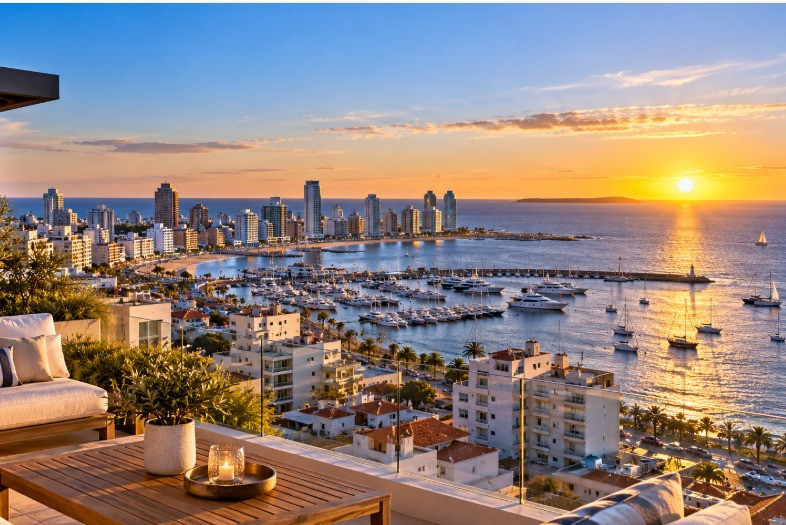
Uruguay can be a good place to invest in property in 2026, but the strongest case is not built on unusually high rental yields or rapid speculation.
The appeal is more balanced. International buyers gain access to an established legal system, widespread US-dollar property pricing, relatively straightforward foreign ownership and several very different markets, from year-round apartments in Montevideo to premium coastal homes in Punta del Este and José Ignacio.
That does not make every property a good investment. Location, property type, management costs, seasonality and eventual resale demand can have more influence on the result than national market averages.
La Cité Real Estate has operated in Uruguay since 1993 and works with international buyers across Montevideo, Punta del Este, La Barra and José Ignacio. Its 2026 market reporting provides a useful picture of where demand and pricing currently differ across the country.

Why Uruguay Attracts International Property Investors
Uruguay offers foreign investors a relatively open investment environment. Uruguay XXI states that foreign investors receive the same advantages as domestic investors under the country's investment framework and are not required to obtain prior authorisation simply to establish investment activity in Uruguay.
For residential property buyers, the practical advantage is straightforward: international buyers can generally purchase homes without first becoming residents.
Uruguay also differs from some emerging property markets because premium real estate is commonly marketed and negotiated in US dollars. This does not remove currency risk for a sterling-based investor, but it can make values easier to compare internationally.
What the Uruguay Property Market Looks Like in 2026
La Cité's 2026 market report shows why Uruguay should be analysed by micro-location rather than as one national market.
Prime coastal areas continue to command the highest values, while Montevideo offers lower entry prices and a more year-round residential environment.
| Location | 2026 Market Character | Investor Consideration |
|---|---|---|
| Montevideo | Year-round urban market with apartments and houses | More consistent residential demand and broader buyer pool |
| Punta del Este | Premium coastal market with strong international visibility | Seasonality, building charges and resale positioning matter |
| José Ignacio | Low-density luxury market with constrained supply | Higher entry cost but strong scarcity in prime locations |
| La Barra | Coastal market between Punta del Este and José Ignacio | Useful middle ground on lifestyle, pricing and access |
Montevideo: The More Stable Rental Proposition

Montevideo is often the more logical starting point for investors whose priority is steady residential demand rather than holiday letting.
La Cité's current guidance places Montevideo property broadly around US$2,000 to US$4,500 per square metre, depending on the neighbourhood, property type, age, condition and quality of the building.
Pocitos, Carrasco and Punta Carretas all operate differently. An apartment close to the Rambla may suit a long-term rental strategy, while a larger house in Carrasco attracts a different buyer and tenant profile.
Read La Cité's Montevideo Real Estate Guide.
Punta del Este: Strong Brand, Stronger Seasonality
Punta del Este is the best-known international property market in Uruguay, but investors need to understand its seasonal nature.
La Cité's 2026 report places new beachfront apartments on the Punta del Este Peninsula at approximately US$4,500 to US$6,800 per square metre, while resale beachfront apartments are indicated around US$3,200 to US$5,000 per square metre.
These ranges are useful market indicators, not valuations for individual units. Sea view, orientation, building age, floor level, parking, amenities and monthly gastos comunes can all create large differences within the same area.
Investors should also avoid judging a property only by peak summer rental rates. A strong January asking rate means little if occupancy drops sharply outside the main season or if high building and management costs absorb much of the income.
Explore La Cité's Punta del Este investment guide.
José Ignacio: Scarcity Rather Than Yield

José Ignacio is not primarily a high-yield market. The investment case is more strongly linked to scarcity, premium positioning and long-term demand for limited coastal stock.
La Cité reports that properties which might have achieved approximately US$6,500 to US$7,000 per square metre in early 2025 were commonly reaching around US$7,500 to US$8,000 per square metre by mid-2026 in the strongest parts of the market.
That does not mean every property has increased at the same rate. Plot position, architecture, proximity to the village and beach, sea views and build quality remain decisive.
Read La Cité's José Ignacio Area Guide.
Foreign Ownership Is Relatively Straightforward
For standard residential property, international buyers can generally purchase without becoming residents first.
An escribano plays a central role in the transaction, checking title, reviewing the seller's legal position, handling the required certificates and completing the formal transfer.
Foreign ownership becomes more specialised when rural property, agricultural activity or corporate structures are involved, so those transactions require additional legal advice.
What Does It Cost to Buy?
The asking price is not the full acquisition budget.
Buyers should also account for the escribano, estate agency commission where applicable, property transfer tax, certificates, registry expenses, banking costs and any inspections or professional advice required.
Uruguay's Dirección General Impositiva currently states that the Impuesto a las Transmisiones Patrimoniales, or ITP, is charged at 2% to the buyer and 2% to the seller in an onerous property transfer. Importantly, the tax base follows the applicable cadastral valuation rules rather than simply being 2% of the advertised sale price.
Read La Cité's complete guide to Uruguay buying costs.
Rental Income Needs to Be Judged Net of Costs
The investment decision should be based on net income, not an advertised gross yield.
- Property management
- Gastos comunes for apartments
- Repairs and maintenance
- Insurance
- Cleaning and turnover for short-term rentals
- Vacancy periods
- Rental-income taxation
For a non-resident individual, Uruguay's DGI states that rental income is subject to IRNR. Where a withholding agent such as an estate agency is involved, monthly withholding is currently calculated at 10.5% of rental income.
The Main Risks Investors Should Consider
Uruguay's relative stability does not remove investment risk.
| Risk | Why It Matters |
|---|---|
| Seasonality | Coastal rental income can be concentrated around the southern summer. |
| Liquidity | Specialist and higher-value property can take longer to sell than mainstream urban stock. |
| Building costs | Amenity-rich developments may carry substantial ongoing gastos comunes. |
| Currency exposure | A UK investor ultimately measures returns in sterling even if the property is priced in US dollars. |
| Property selection | Two homes in the same neighbourhood can perform very differently depending on view, condition, amenities and exact location. |
What Makes a Better Uruguay Investment Property?
A stronger investment tends to combine a location with proven demand and a property that remains attractive beyond one specific buyer profile.
- Walkable access to established amenities
- Good natural light and orientation
- Parking where local buyers expect it
- Manageable building or maintenance costs
- Strong condition or a clearly costed renovation plan
- Appeal to both future owner-occupiers and tenants
- Clear legal documentation and straightforward title
How La Cité Helps Investors Assess the Market
La Cité's role goes beyond showing properties.
The agency works across several different Uruguay property markets and can help international buyers compare current inventory, location, asking values and practical ownership costs before committing.
For overseas owners, La Cité also provides property management and relocation support, which is particularly relevant when an investment property will be left vacant or rented while the owner is abroad.
Considering property investment in Uruguay?
Speak to La Cité Real Estate to compare current opportunities in Montevideo, Punta del Este, La Barra and José Ignacio.
Call the Punta del Este office on +598 4244 5368 or email lacite@lacite.com.uy.
Frequently Asked Questions
Is Uruguay a good place to invest in property in 2026?
It can be, particularly for investors prioritising diversification, relatively straightforward ownership and established coastal or urban markets. The investment case should still be tested against actual costs, rental demand and resale potential.
Can foreigners buy property in Uruguay?
Foreign buyers can generally purchase standard residential property without first obtaining residency. Rural property and corporate structures can require additional legal analysis.
Is Montevideo or Punta del Este better for investment?
Montevideo tends to offer a more year-round residential market. Punta del Este provides stronger international recognition and summer rental potential but is considerably more seasonal.
Is José Ignacio a good investment?
José Ignacio can appeal to investors focused on scarcity and premium long-term positioning rather than maximum rental yield. The strongest areas have shown meaningful price growth, but performance varies significantly between properties.
What tax does a buyer pay when purchasing property?
Uruguay's DGI currently applies a 2% ITP rate to the buyer in an onerous property transfer. The taxable amount is based on the applicable cadastral valuation rules rather than simply the advertised sale price.
So, Should You Invest in Uruguay?
Uruguay makes the strongest case for investors who value stability, international diversification and the option to combine financial ownership with personal use.
It is less compelling for investors expecting highly leveraged purchases, rapid resale or unusually high passive yields.
Montevideo offers a more conventional year-round investment market. Punta del Este brings international recognition and seasonal demand. José Ignacio offers scarcity and premium positioning. The right choice depends on whether you prioritise rental income, capital preservation, lifestyle use or long-term appreciation.
Contact La Cité Real Estate to assess current opportunities against your investment objectives.